Get Your Free Tree Estimate
Upload a photo on this page. You do not leave this guide.
Emergency tree service in Texas costs $300–$8,000 on ArborHub’s 2026 statewide base rates. A small tree runs $300–$800. Medium is $800–$1,800. Large is $1,800–$4,000. Extra-large is $4,000–$8,000. Those are the same numbers the city emergency pages start from, before a local multiplier.
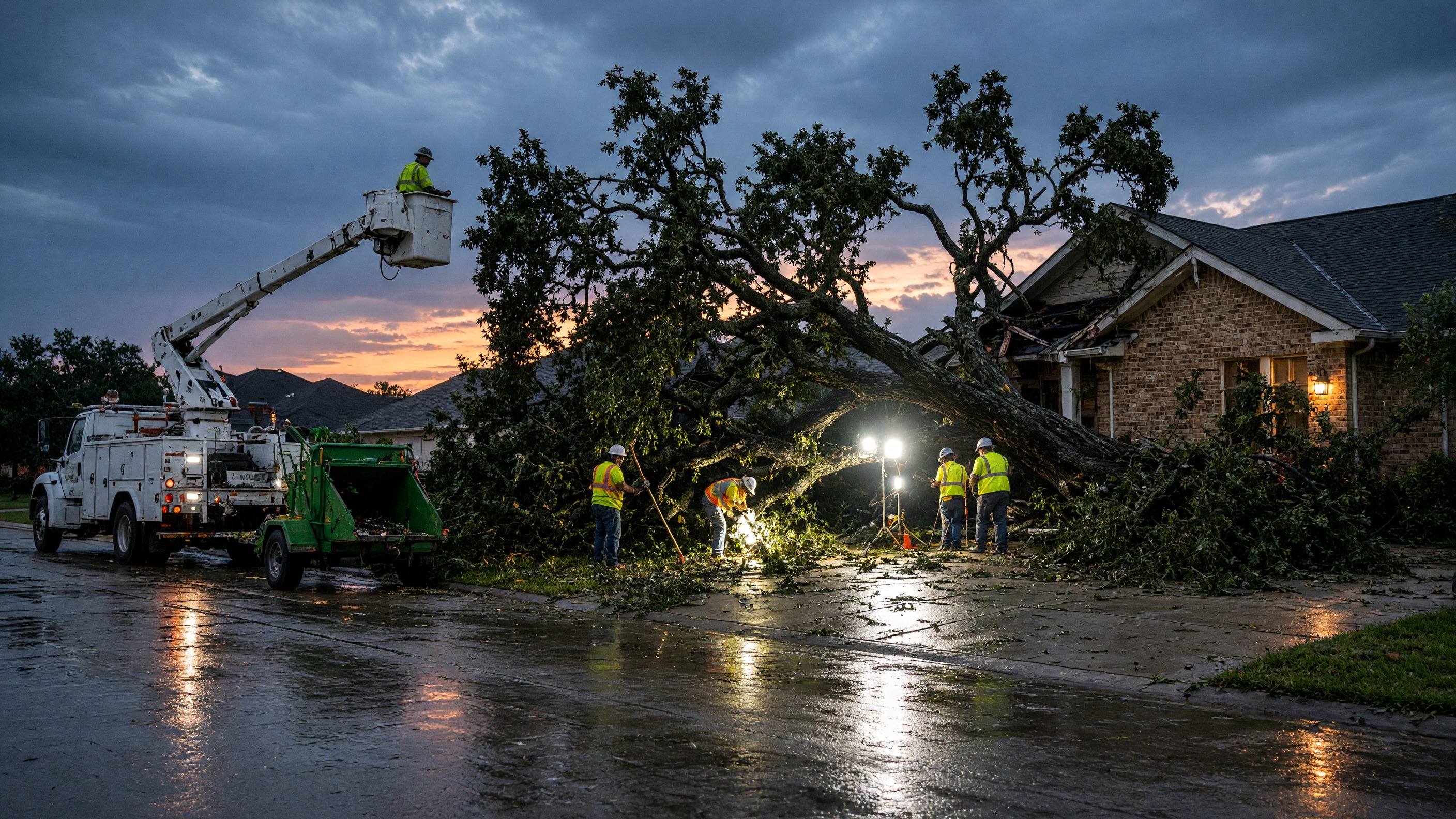
“Emergency” here means a tree that has fallen or is failing and is on, over, or threatening a house, garage, vehicle, road, or line. Storm damage is the usual case: a limb through the roof, a split trunk across the fence, a whole tree across the driveway. A tree that leans a little more than it did last year, with nothing under it, is a scheduled job.
Emergency base rates run about 1.5–2× ArborHub’s scheduled removal rates. A medium tree is $800–$1,800 as an emergency and $450–$1,200 as a scheduled removal.
Emergency costs by tree size
| Tree size | Typical height | Low | High |
|---|---|---|---|
| Small | Under 25 ft | $300 | $800 |
| Medium | 25–50 ft | $800 | $1,800 |
| Large | 50–75 ft | $1,800 | $4,000 |
| Extra large | 75+ ft | $4,000 | $8,000 |
Size is height, in the same bands ArborHub uses for scheduled removal and trimming. Estimate the height before you call, from the ground to the top of the tree as it stood. That number picks your row. If the tree is in pieces, count the fallen part too: the crew has to cut and haul all of it.
Here is the same table next to scheduled removal. The ratio is the emergency figure divided by the scheduled figure at the same end of the range, rounded to one decimal.
| Tree size | Emergency | Scheduled removal | Ratio (low / high) |
|---|---|---|---|
| Small | $300–$800 | $150–$450 | 2.0× / 1.8× |
| Medium | $800–$1,800 | $450–$1,200 | 1.8× / 1.5× |
| Large | $1,800–$4,000 | $1,200–$2,500 | 1.5× / 1.6× |
| Extra large | $4,000–$8,000 | $2,500–$5,000 | 1.6× / 1.6× |
The ratio never drops below 1.5× and tops out at 2.0× on the low end of a small tree. In dollars the gap grows with the tree. On a small tree the emergency premium is $150 at the low end and $350 at the high end. On an extra-large tree it is $1,500 and $3,000.
If the tree is standing, cracked, and not yet on anything, you may have a choice. Read how to assess storm damage first. A tree that can wait a week for a scheduled crew costs the scheduled rate in tree removal cost in Texas.
Why emergency work costs more
These are the reasons contractors give for quoting emergency work higher. One job can involve several of them.
- After-hours crews. Trees come down at night, on weekends, and during holidays. A crew that rolls out at 10 p.m. is paid for that, and the contractor passes it through.
- Hazardous rigging. A tree loaded against a roof or wall is under tension. Cut it in the wrong place and it shifts onto the structure or springs back at the climber. Crews rope pieces down one at a time instead of dropping them. That takes more people and more hours than felling the same tree in an open yard.
- Crane or bucket truck. A climber cannot always tie in safely to a broken tree. When the tree is too damaged to climb, or too heavy to lower by rope over a house, the crew brings a bucket truck or a crane. Either one adds a machine and an operator to the quote.
- Storm-week demand. After a wind, hail, or ice event, every crew in the county has a list. Contractors price the backlog. A call on day one joins every other storm call in that contractor’s queue.
- Haul-away. A storm-broken tree is a full tree’s worth of wood in awkward pieces, often tangled in fence, gutter, or roofing. Loading and hauling it is billed as part of the job.
Ask the contractor which of these apply to your tree. A quote that names them is easier to compare with a second quote, and easier to hand to an insurance adjuster.
Will insurance pay?
Sometimes. It depends on what the tree hit, and on your policy. Check your policy before you sign a contractor’s quote.
Usually covered. Most standard homeowners policies cover tree removal when a tree damages a covered structure: the house, a detached garage, a fence. Coverage for the removal itself often has a per-tree or per-event cap. That cap is usually separate from what the policy pays to repair the structure. Look for both lines in your policy, or ask your agent.
Usually not covered. A standing tree, even a dead or cracked one, is usually your cost. So is a tree that fell in the yard without hitting anything covered. Removing a hazard before it falls is maintenance in most policies, not a claim.
What helps the claim.
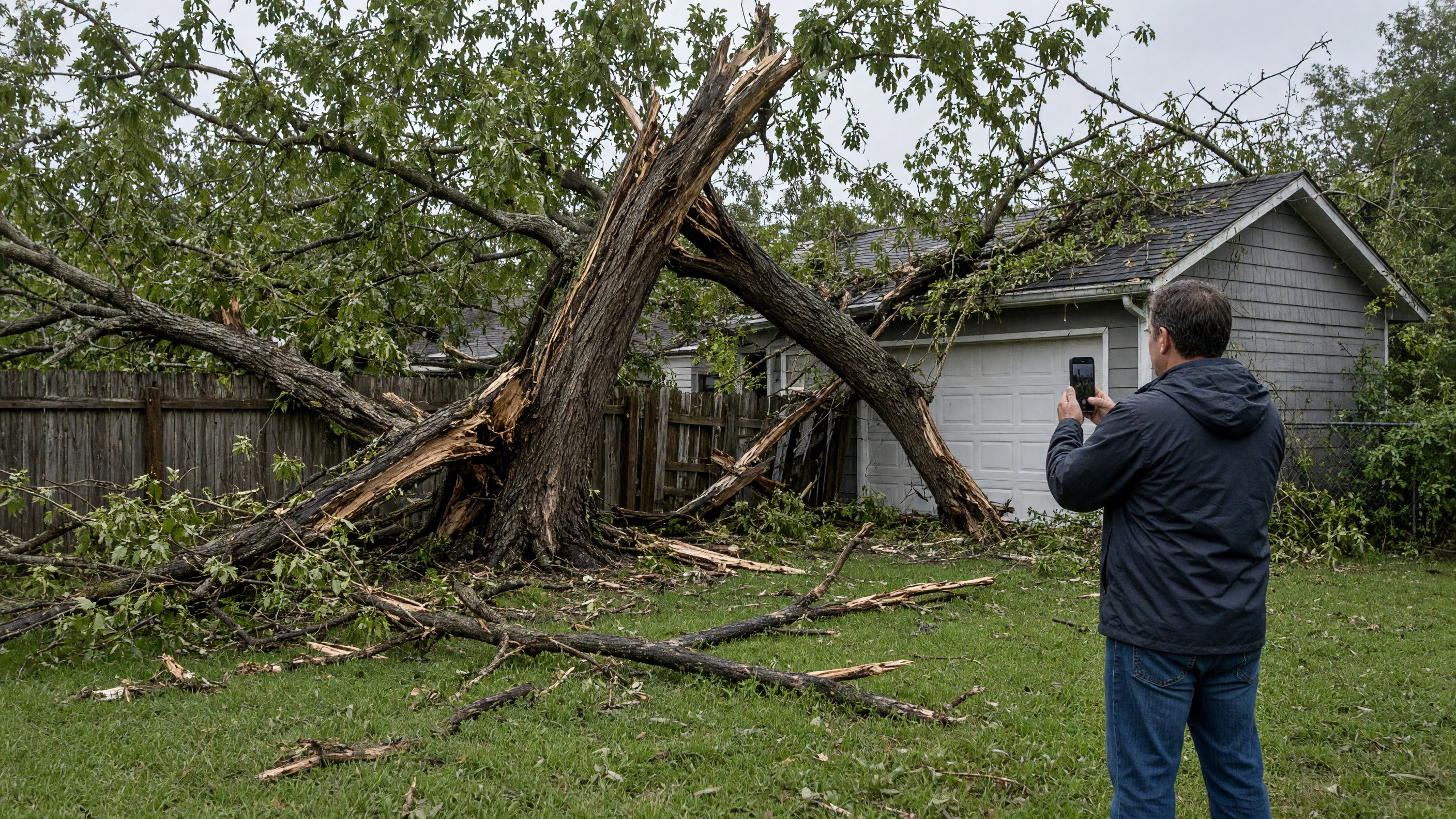
- Photograph everything before any work starts. Take wide shots that show the whole tree and the structure, then close-ups of every contact point, the break or the root plate, and any damage inside the house.
- Ask the contractor for an itemized invoice. Removal from the structure, rigging, equipment, and haul-away should each be a line. An adjuster needs to see which part of the bill was getting the tree off the house.
- Keep the invoice, the photos, and the date together. Send them with the claim, not after.
City comparison (medium tree)
Medium emergency base is $800–$1,800. Multipliers match ArborHub city pages. These are the base rates each city’s emergency page starts from.
| City | vs state | Medium emergency |
|---|---|---|
| Austin | +15% | $920–$2,070 |
| Dallas | +10% | $880–$1,980 |
| Houston | +5% | $840–$1,890 |
| San Antonio | −5% | $760–$1,710 |
| Fort Worth | +5% | $840–$1,890 |
| Plano | +15% | $920–$2,070 |
ArborHub has emergency pricing pages for 30 Texas cities. Each one applies the same multiplier to all four tree sizes, so you can do the arithmetic for any row yourself. Multiply the statewide range by the city factor:
- Large tree in Dallas: $1,800–$4,000 × 1.10 = $1,980–$4,400.
- Large tree in Houston: $1,800–$4,000 × 1.05 = $1,890–$4,200.
- Extra-large tree in Austin: $4,000–$8,000 × 1.15 = $4,600–$9,200.
- Small tree in San Antonio: $300–$800 × 0.95 = $285–$760.
The city pages show all four sizes already multiplied out. Use them when you want the number for your city without the math.
What to do in the first hour
- Stay clear of the tree. Keep people and pets away from it and from anything under it. A tree resting on a roof, a fence, or another tree can move again. If the tree came through the roof or anyone smells gas, get everyone out and call 911 first.
- If a line is down or involved, call the utility first. Do not let anyone cut: not you, not a neighbor with a chainsaw, not a tree crew. Treat every wire in or near the tree as live until the utility says otherwise.
- Photograph the scene. Do it before anything is moved or cut. The insurance section above lists what to shoot.
- Call two contractors. Ask each one two questions: can you come today, and what is your call-out minimum? Then ask whether haul-away is included and whether they expect to need a crane or bucket truck. The call-out minimum is the smallest bill the contractor will write for sending a crew at all. Get it in dollars before the truck leaves their yard, and write down who quoted what.
- Do not pay in full before the work is done. Pay the balance when the tree is off the structure and the debris is gone.
Once the tree is down, the stump is a separate decision. Ask whether the quote includes grinding, and see stump grinding cost in Texas if it does not.
Frequently asked questions
How much does emergency tree removal cost in Texas?
$300–$8,000 on ArborHub’s 2026 statewide base rates. Small trees under 25 ft run $300–$800, medium $800–$1,800, large $1,800–$4,000, and extra-large $4,000–$8,000. City multipliers move a medium tree from $760–$1,710 in San Antonio to $920–$2,070 in Austin and Plano. Multipliers can also push the top above $8,000: Austin’s multiplier puts an extra-large emergency at $4,600–$9,200.
Does homeowners insurance pay for emergency tree removal?
Most standard homeowners policies cover removal when a tree damages a covered structure such as the house, a detached garage, or a fence, often with a per-tree or per-event cap. A standing tree, or a tree that fell in the yard without hitting anything, is usually not covered. Check your policy, photograph everything before work starts, and ask the contractor for an itemized invoice.
Why is emergency tree work 1.5–2× the normal price?
On ArborHub’s base rates, emergency pricing divided by scheduled removal pricing runs from 1.5× to 2.0× across the four tree sizes. A medium tree is $800–$1,800 as an emergency and $450–$1,200 scheduled. Contractors quote higher for after-hours crews, rigging a tree that is loaded against a structure, crane or bucket truck time, storm-week demand, and haul-away.
Can I get an emergency tree service the same day?
It depends on the week. After a storm, crews are often booked out. Call two contractors and ask each whether they can come today and what their call-out minimum is. If a power line is down or touching the tree, call the utility first and do not let anyone cut until it is cleared.